Claypot Chicken with Bitter Gourd
This is my mother’s recipe. I’ve never acquired the taste for bitter gourd all these years though I know it is packed with nutrients and goodness. I am informed that this dish – Chicken with Bitter Gourd is a favourite amongst many who like bitter gourd. I am also informed that the bigger and older the bitter gourd, the less bitter it is.
So, I thought why not I post it up here on this blog for those who like to eat chicken with bitter gourd but do not know how to cook it. My mum used the claypot to retain the warmth of the dish as well as to ensure that the chicken and bitter gourd continue to simmer slowly though it has been removed from the cooker. If you don’t have a claypot, it doesn’t really matter. Just serve it on a plate.
This is my mother’s recipe for Claypot Chicken with Bitter Gourd.
Ingredients
- 1 large bitter gourd (wash, remove seeds, cut halved across the bitter gourd and then, cut to chunk bite sizes)
- 2 whole chicken legs (remove skin and cut to chunky bite sizes. You can keep the skin if you don’t mind the dish slightly oily)
- 5 pieces dried chinese mushrooms (pre-soaked till soft and cut to two with stems discarded)1 1/2 tablespoons tau cheo
- 4 cloves garlic (chopped)
- 2 tablespoons cooking oil (preferably palm oil)
- 1 cup warm water
Seasoning
- 1 1/2 teaspoons dark soya sauce
- Salt to taste
- a pinch of sugar
Method
Heat oil in wok and stir-fry garlic and tau cheo for 30 seconds. Add chinese mushrooms, chicken and bitter gourd and continue stir-frying till outer layer of chicken meat is cooked.
Add seasoning and water enough to cover the ingredients. Bring to boil. Meanwhile, if you have a claypot, heat it up whilst waiting for the gravy to boil in the wok.
Once the gravy is boiling, transfer contents into claypot and simmer for 15 minutes on medium heat till gravy reduced to your liking. If you do not have a claypot, simmer likewise.
source:http://www.deliciousasianfood.com
It was difficult for me to find the exact English equivalent for Sweet Tau Kee or Sweet Tou Kan, a type of soya product which is popular amongst vegetarians. Sweet Tau Kee comes in rectangular dried hard pieces and are brown in colour and you will need to soften them by pre-soaking in water for a few minutes prior to cooking. I have had experience where certain Sweet Tau Kee softens much faster than others depending on different manufacturers. After they have softened, you should cut them into smaller pieces as they measure approximately 15cm in length and 5 cm in width prior to cooking.
Sweet Tau Kee is not for everyone due to its unique taste, which can be bitter to some. Here, I have paired the Sweet Tau Kee with Choy Sum (èœå¿ƒ) or “Flowering Chinese Cabbage” so that there is a good balance between the subtle sweetness of the Tau Kee and the refreshing Choy Sum greens. This dish is quite easy to cook and with a little effort in presentation, you can dish out something which can rival what is being offered in the chinese restaurants. By the way, if you intend to serve this as a complete vegetarian dish, omit garlic from the ingredients.
This is my recipe for Choy Sum with Sweet Tau Kee
Ingredients
- 200 grammes Choy Sum (choose tender shoots, rinsed thoroughly to remove dirt)
- 3 pieces Sweet Tau Kee (pre-soak till soft enough to cut with scissors, yet with a little firmness. Cut into desired sizes)
- 3 cloves garlic (sliced thinly)
- Water for blanching Choy Sum
- Potato starch (mix 1 teaspoon potato flour with 100 ml water)
- 2 tablespoons peanut / corn oil
Seasoning
- 1 tablespoon mushroom / abalone flavoured sauce
- A pinch of salt
- A couple of dashes of white pepper powder
Method
Bring to boil in a pot or wok. Add a liberal pinch of salt and a couple of drops of cooking oil. Whilst water is boiling rapidly, add Choy Sum and blanch it until the leaves turn dark green, indicating that it is cooked. Remove and drain. Arrange Choy Sum on a plate.
Heat cooking oil in wok and fry the sweet tau kee for 1 minute on both sides on medium high heat. Once done, push the sweet tau kee to one side and add garlic to remaining oil. Saute till aromatic.
Then, push back the sweet tau kee to the garlic and add 200 ml water. Bring gravy to boil and add seasoning to taste. Gradually add potato starch to thicken gravy to your preferred consistency. Then, pour gravy with sweet tau kee and garlic over the pre-arranged Choy Sum.
source:http://www.deliciousasianfood.com
Label: Choy Sum with Sweet Tau Kee

I love simple to cook dishes. And with vegetables, I like them quickly cooked so as to retain the texture and nutrition. Hence, this dish is one of my favourites. Choy Sum (sometimes known as Chinese Mustard Leaves or Chinese Flowering Cabbage or Sawi) is one of the most popular leafy greens available in markets in South East Asia. It can be cooked and eaten on its own or cooked with other ingredients.
In most chinese restaurants (especially those in Malaysia), you can order this dish but the price which they charge (approximately RM6.00 and above for a plate) does not justify the price of Choy Sum and the ease of preparation. It’s like getting ripped off. If you can get them from the market, you can cook this dish by your self at home. As long as you know how to boil water and fry “something”, you can be a chef just like those at chinese restaurants.
This is the recipe for Choy Sum with Oyster Sauce
Ingredients
- Choy Sum (amount up to you really, just wash them thoroughly. Then, pluck and separate the stem from the leaves. For the thicker part of the stem, try to remove the “skin” using a knife)
- About 5 bulbs of shallots and / or garlic (slice shallots or finely chopped garlic)
- 1/2 teaspoon of salt + 1 tablespoon of palm oil
- 3 tablespoons of palm oil (for frying)
- Water for boiling
Seasoning
- Oyster sauce (amount up to you)
Method
Heat up 3 tablespoons of palm oil in a wok and fry the shallots or garlic till golden brown. Remove fried shallots / garlic and set aside. Keep the oil separately.
Meanwhile, bring water to boil in a pot. Once it starts boiling, add salt and 1 tablespoon of palm oil. Allow water to boil briskly.
Add choy sum stems into the boiling water. Add leaves approximately 15 seconds after that. Stir well to ensure even blanching.
Once leaves have turned dark green (which is really beautiful!), remove leaves and stem from pot and arrange on a plate.
Drizzle the oil (which was used to fry the shallots / garlic) over the cooked choy sum followed by oyster sauce and top it up with fried shallots / garlic.
Label: Choy Sum with Oyster Sauce

It’s time for another comfort soup and this time, I am featuring the Chinese White Radish Soup. The chinese white radish is also known as white radish (surprise!) or amongst the Japanese as the Daikon Radish. It basically looks like a white carrot which is oversized. It is quite a versatile vegetable as you can use it to make lo bak kou (turnip cake), stirfried, pickled or cooked in soups like the above. I am given to understand that amongst the chinese who practice or partake in traditional herbal medicine, the white radish is a no-no in the diet of the patient during treatment as it supposedly absorbs all the medicinal values. Anyone knows about this?
Anyway, the Chinese White Radish Soup is a simple recipe which is suitable even for beginners. Just prepare the ingredients, drop them into a crockpot / slow cooker / double-boiler or pot and simmer it. A good tasting healthy soup awaits you when it is done. I usually add dried cuttlefish and dried oysters for added taste and flavour but that is optional. Give this soup a try. It’s delicious.
This is my recipe for Chinese White Radish Soup
Ingredients
- 300 grammes pork ribs / bony pork or chicken parts
- 1 white radish (about 200 grammes or more – cut into large chunks or sliced)
- 8 red dates
- 1 piece dried cuttlefish
- 6 pieces dried oysters
- 700 ml water for soup (or approximately 2 1/2 soup bowls of water)
- 500 ml water
Method
Bring to boil 500 ml water in a pot. Add pork ribs / chicken part and allow the meat to cook slightly. Remove scum from surface of water. Remove meat and discard water.
Bring to boil 700 ml water in a clean pot. Add the partially cooked meat and the rest of the ingredients and bring back to boil. Then reduce heat to simmer for 2 to 3 hours or till soup reduced to 1 1/2 bowls water. Add salt to taste before serving.
If you are using a crockpot or double-boiler, reduce amount of water to just over a soup bowl. Add ingredients into pot. Boil the water separately and pour the boiling water into the pot before simmering. Enjoy your chinese white radish soup.
Label: Chinese White Radish Soup

There are many duck recipes available out there and I am a lover of duck meat. Yet, I must confess that despite there being such a big variety of duck recipes, I am still partial to the chinese duck recipes – peking duck, roasted duck and stewed duck. Today, I shall share with you my wife’s family recipe for stewed duck. We call it Lor Ark in Hokkien.

This duck recipe uses dark soya sauce and some simple ingredients to give the duck an aromatic flavour yet retain the juiciness of the flesh. If you can get hold of the ingredients mentioned, I would recommend that you try this recipe for you will be amazed by how easy it is to cook a wonderful and delicious stewed duck dish.
This is my wife’s recipe for Chinese Stewed Duck
Ingredients
- 1 whole duck (approx 2 kgs)
- 3 inches galangal (lengkuas)
- 8 shallots
- 4 cloves garlic
- 50 grammes 5 spice powder
- 3 tablespoons dark soya sauce
- 2 tablespoons sugar
- salt to taste
- 1 litre hot water
- 4 tablespoons cooking oil
Method
Clean duck thoroughly by rubbing it with some salt. Rinse. Rub about 30 grammes of 5 spice powder over the duck and allow to marinade for 1 to 2 hours.
Pound the galangal, garlic and shallots separately.
Heat 2 tablespoons of oil in wok and saute shallots till aromatic. Remove shallots. Add garlic and saute till aromatic. Remove garlic. Add galangal and saute till aromatic.
Return shallots and garlic into the wok and stir together with galangal till even. Add dark soya sauce and sugar. Stir well.
Add duck and coat it with mixture. Allow duck to cook and shrink slightly. Control heat so that duck does not burn. Once duck has shrunk slightly, add about 200 ml water and allow it to boil. Continue with another 200 ml and repeat process till 1 litre of water used. The water should be filled up to at least half the duck. Add remaining 5 spice powder and reduce heat to simmer.
Stew / simmer for 1.5 hours turning every 10 minutes. Add salt to taste and water if it is drying out.
Remove duck and drain off excess gravy. Allow to cool before serving with gravy (sieve gravy to remove spices before serving).
Label: Chinese Stewed Duck
There are many duck recipes available out there and I am a lover of duck meat. Yet, I must confess that despite there being such a big variety of duck recipes, I am still partial to the chinese duck recipes – peking duck, roasted duck and stewed duck. Today, I shall share with you my wife’s family recipe for stewed duck. We call it Lor Ark in Hokkien.
This duck recipe uses dark soya sauce and some simple ingredients to give the duck an aromatic flavour yet retain the juiciness of the flesh. If you can get hold of the ingredients mentioned, I would recommend that you try this recipe for you will be amazed by how easy it is to cook a wonderful and delicious stewed duck dish.
This is my wife’s recipe for Chinese Stewed Duck
Ingredients
- 1 whole duck (approx 2 kgs)
- 3 inches galangal (lengkuas)
- 8 shallots
- 4 cloves garlic
- 50 grammes 5 spice powder
- 3 tablespoons dark soya sauce
- 2 tablespoons sugar
- salt to taste
- 1 litre hot water
- 4 tablespoons cooking oil
Method
Clean duck thoroughly by rubbing it with some salt. Rinse. Rub about 30 grammes of 5 spice powder over the duck and allow to marinade for 1 to 2 hours.
Pound the galangal, garlic and shallots separately.
Heat 2 tablespoons of oil in wok and saute shallots till aromatic. Remove shallots. Add garlic and saute till aromatic. Remove garlic. Add galangal and saute till aromatic.
Return shallots and garlic into the wok and stir together with galangal till even. Add dark soya sauce and sugar. Stir well.
Add duck and coat it with mixture. Allow duck to cook and shrink slightly. Control heat so that duck does not burn. Once duck has shrunk slightly, add about 200 ml water and allow it to boil. Continue with another 200 ml and repeat process till 1 litre of water used. The water should be filled up to at least half the duck. Add remaining 5 spice powder and reduce heat to simmer.
Stew / simmer for 1.5 hours turning every 10 minutes. Add salt to taste and water if it is drying out.
Remove duck and drain off excess gravy. Allow to cool before serving with gravy (sieve gravy to remove spices before serving).
Label: Chinese Stewed Duck

My mother-in-law made some chinese roast pork when we were in Kuching for the Chinese New Year. Chinese roast pork here refers to siew yuk (in cantonese) or sio bak (in hokkien). With a crispy crackling roasted skin and semi-tender meat, you can be assured of spoonfuls after spoonfuls of rice to go with it. No wonder I put on weight over Chinese New Year!

In Malaysia, there are many roast pork rice stalls around. It is very popular. A plate of white / fragrant rice with a few cuts of these roast pork and a couple of pieces of sliced cucumbers can cost about USD1.00 on the average depending where you go to. Very cheap, right? Absolutely.
This is my mother-in-law’s recipe for Chinese Roast Pork and the measurements are approximate only because she cooks it more by feel than using a strict recipe to follow.
Ingredients
1 piece of pork belly weighing approximately 1 kg3 tablespoons of coarse / rock salt2 tablespoons of fine salt1 tablespoon of five-spice powder
Method
Clean pork belly and pat dry with kitchen towel. Rub fine salt and five-spice powder on meat. Rub coarse salt on skin.
Heat up oven at gas mark 4 (about 180 degrees celcius). Place pork belly on a rack with a tray underneath to catch dripping oil. Roast the pork belly for at least 30 minutes and until the coarse salt crystalises just like in the picture above.
Remove the salt crystals and continue to roast till the skin is crispy. (Alternatively, what my mother-in-law did was to remove the pork belly and fry the pork belly in a wok with skin-downwards and without oil on medium heat till the skin turned crispy)
I have heard of some of the chinese roast pork recipe which called for the pork belly skin to be poked with a sharp knife so as to enable the fat to ooze out faster during roasting. You can try this additional step as well prior to rubbing the coarse salt. source:http://www.deliciousasianfood.com
Label: Chinese Roast Pork
Chinese leek flower can be considered a delicacy in chinese cuisine. It belongs to the same family as onions and is highly nutritious and sweetly flavoured. Usually, the “flower” is eaten before it blooms.
A secret to good tasting leek flower is to remove the “skin” very carefully from the stem. This layer of “skin” is as thin as cling-film and takes some practice to remove them.
Try not to use a knife as you will remove the outer-layer of the stem instead. Once you have removed the transparent looking “skin”, you are on the right track.
I usually cook the leek flower with beancurd (firm type), prawns and carrots. You can also throw in roasted pork for added flavour.
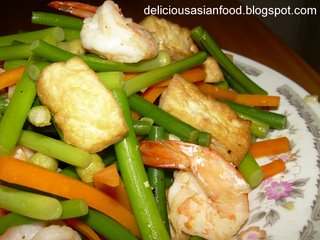
This is my recipe for Chinese Leek Flower with Beancurd, Carrots and Prawns.
Ingredients
- 200 grammes chinese leek flower (cut into an inch lengthwise, remove skin)
- 100 grammes carrots (cut into strips)
- 2 pieces of beancurd (hard type. Cut into strips and fry them till brown)
- 100 grammes of medium-sized prawns (keep tail intact and devein)
- 2 bulbs garlic (minced)
- 1 tablespoon cooking oil
- 50 ml warm water
Seasoning
- 1 tablespoon oyster sauce
- Dash of white pepper
Method
Heat oil and fry garlic for 15 seconds or so. Add leek flower, carrots, prawns and pre-fried beancurd. Stir-fry till prawns are cooked.
Add seasoning and warm water and close lid. Cook for another 3 to 5 minutes. Add a little bit more water if the dish dries up.
If you want to add roast pork, chop the roast pork (amount up to you) and add it into the dish before seasoning. You might want to reduce the oyster sauce because roast pork can be a bit salty.
Serve hot with rice.
source:http://www.deliciousasianfood.com

If you are looking for a delicious pork recipe which tastes sweet and hot, Chilli Pork might just be what you are looking for. Using dried chillis for a fiery taste and dark soya sauce, this dish is guaranteed to whet your appetite and make you ask for second helpings of rice. Best of all, it is a simple dish to cook and can be attempted by a beginner.
I use pork belly for this recipe due to the texture of this part of the meat. Containing layers of fat and meat, each bite will give you a nice blend of slightly chewy meat in contrast with the smooth fat. No, it is not that healthy to be consuming this dish but once a fortnight or month should be fine. LOL! Again, just like the other recipes on this site, you don’t have to follow all the measurements of ingredients to the dot. If you like it more spicy, add more dried chillis or vice versa. Most of all, cook this and be blown away by its tastiness! Highly recommended!
This is my recipe for Chilli Pork
Ingredients
- 200 grammes pork belly (sliced thinly)
- 4 pieces dried chilli
- 8 cloves garlic (chopped finely)
- 200 ml hot water
- 2 tablespoons cooking oil
Seasoning
- 1 1/2 tablespoons dark soya sauce
- 2 1/2 teaspoons sugar
- 1/4 teaspoon salt
- white pepper powder to taste
- 1/2 teaspoon chinese cooking wine
Method
Heat oil in wok and saute dried chilli with garlic till aromatic.
Before garlic turns brown, add sliced pork and stir well. Add sugar and dark soya sauce. Once pork is cooked on outer side, add water gradually (ensure that water continues to boil) followed by salt, pepper and chinese cooking wine. source:http://www.deliciousasianfood.com
Label: Chilli Pork

Chilli Garlic Tofu Snack is just a name I use to describe this dish because I am unaware whether there is an original name to this dish. Just like the Ikan Bilis Snack, this is another one of those easy to cook yet delicious food. And extremely affordable too.
The garlic gives this dish an aromatic flavour whilst the use of chilli and white pepper powder gives this dish a slight spiciness to it. If you intend to serve this dish to kids, just omit the use of chillis and white pepper powder. It tastes just as great. Try it will ya?
This is my recipe for Chilli Garlic Tofu Snack
Ingredients
4 cloves garlic (chopped)
1 to 2 pieces red chilli (remove seeds and chopped finely)
4 tablespoons cooking oil (palm oil)
Seasoning
At least one teaspoon of dark soya sauce (or to taste)
A pinch of salt
a couple of dashes of white pepper powder
Method
Heat oil and fry tofu till golden brown and crisp using high heat. Remove fried tofu and discard oil.
The wok should still be coated with oil at this moment. Add garlic and chilli and saute till aromatic. Return fried tofu to the wok, add seasoning and stir well to coat evenly prior to serving.
source:http://www.deliciousasianfood.com
Label: Chilli Garlic Tofu Snack

I am back after the long festive holidays. I had the chance of cooking a couple of dishes and this is one of them. My mum cooks this dish quite often too. I guess it’s because it is quite easy and simple to cook. I usually remove the skin of the chicken prior to cooking this dish for health reasons. Furthermore, I don’t like the dish to turn out with a layer of oil. In the picture below, I have yet to remove the skin.
Once you have mastered this dish, you can experiment with the ingredients – eg. adding baby corn, different types of mushrooms, celery etc.
This is my recipe for Chicken with Potatoes, Carrots and Mushrooms.
Ingredients
- 2 chicken drumsticks & thigh (chop to desired size)
- 1 medium sized carrot (cut to wedges)
- 2 small sized potatoes (cut to wedges)
- 4 pieces dried chinese mushrooms (pre-soaked)
- 5 cloves garlic (chopped)
- 3 tablespoons cooking oil (preferably palm oil)
- 1 cup warm water
Marinade
- 3 teaspoons light soya sauce
- a couple of dashes of white pepper powder
- 1 teaspoon of corn flour
Seasoning
- 1 1/2 tablespoons oyster sauce
- 1 teaspoon dark soya sauce
- Salt to taste
Method
Marinade chicken for 30 – 60 minutes. Meanwhile, heat oil in wok and fry potatoes till golden brown. Remove fried potatoes from oil.
With remaining oil in wok and at medium heat, saute the chinese mushrooms for 1 minute. Increase to high heat and add chicken and garlic and stir fry for another minute till outer layer of chicken is cooked. Add fried potatoes and carrots and continue stir frying for another minute.
Add seasoning and water and close lid. Cook for another 3 minutes or until chicken is thoroughly cooked.
source:http://www.deliciousasianfood.com
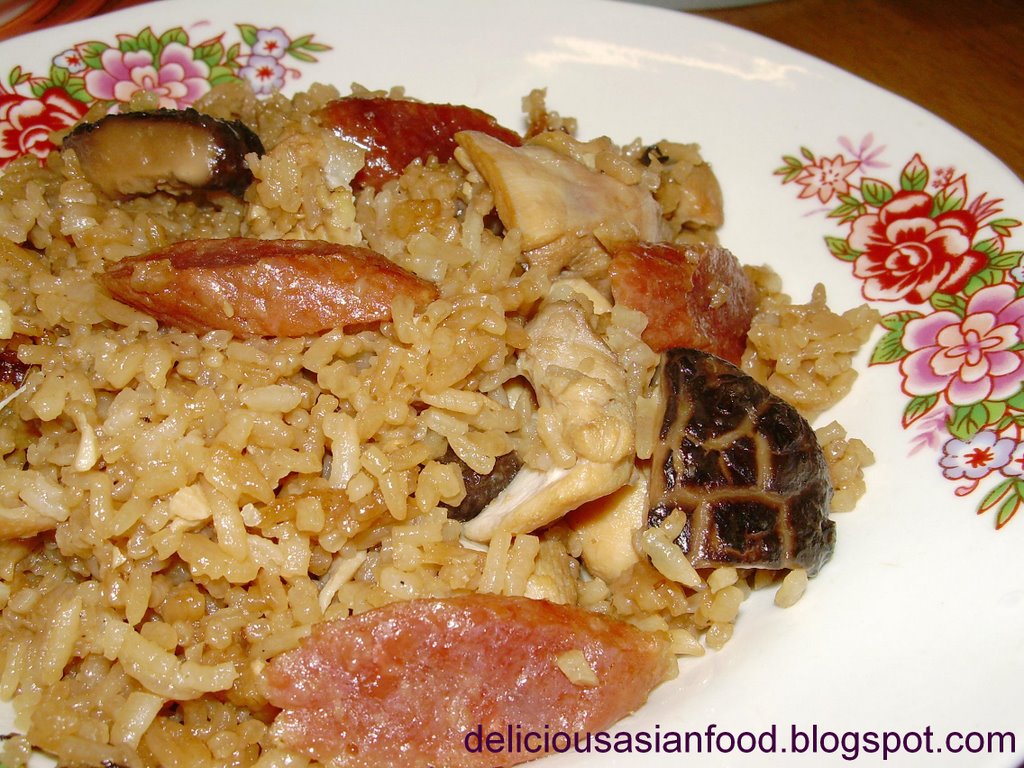
The rice cooker is a very useful kitchen equipment and is present in many Asian households. Whilst it is primarily designed to cook rice, newer versions of the rice cooker has enable cooks to use it for steaming and even boiling soup.
Recently, my mum cooked Chicken Rice using the rice cooker. It is actually another version of the popular Claypot Chicken Rice. The beauty of using the rice cooker is that the rice does not get burnt at the bottom unlike the claypot. However, for those who are fond of burnt bits of rice, you may have to try this using the claypot instead.
This is the recipe for Chicken Rice using the Rice Cooker.
Ingredients
- 3 cups of rice (measure using the cup that comes supplied together with the rice cooker)
- 2 large chicken drumsticks and chicken thighs (chopped to bit sizes)
- 5 chinese dried mushrooms (pre-soaked in a bowl of water and cut to half or quarters. Do not throw away the water used for soaking)
- 2 chinese lap cheongs (chinese sausages) (sliced)
- 4 bulbs shallots (sliced thinly)
- 5 slices of ginger (more if you like a stronger ginger taste)
- 2 tablespoons of cooking oil
- warm water
Marinade for chicken
- 3 tablespoons oyster sauce
- 2 teaspoon of white pepper powder
- 1 teaspoon of sesame oil
- 1 tablespoon of chinese cooking wine
Seasoning
- 5 teaspoons of light soya sauce
- 1 tablespoon of dark soya sauce
Method
Soak rice in water for about 1 1/2 hours. Marinade chicken for the same length of time.
Heat oil in wok and fry shallots till golden brown. Remove fried shallots.
With remaining oil in wok and at high heat, add pre-soaked chinese dried mushrooms and ginger and stir fry for about 1 minute. Add marinated chicken and stir fry for another minute.
Add pre-soaked rice and seasoning and continue frying for about 2 minutes. Sprinkle a little bit of warm water to keep the rice from drying out.
Remove rice with ingredients into the rice cooker. Place the lap cheongs over the rice. Pour water (previously used to soak dried chinese mushrooms) gently over the rice to cover the rice just like how you would usually cook white rice in a rice cooker. Add plain water if the water used to soak dried chinese mushrooms is insufficient. Turn on your rice cooker and let it cook.
Serve hot and sprinkle fried shallots over the rice prior to serving.
source:http://www.deliciousasianfood.com

Chicken Chop is known to be a western dish and is commonly found in most western restaurants. In Malaysia, chicken chop is sometimes served in Chinese restaurants which serve western dishes and it is usually accompanied with a tomato based gravy.
Recently, I tried cooking chicken chop for a change from the usual dishes we have for dinner. I bought two chicken legs (which consists of the thigh and drumstick) which I had it deboned. Apart from the chicken legs, the only other ingredients I used were cherry tomatoes and onions, excluding the marinade and seasoning, of course. It is fairly simple and not an intimidating dish to cook. To make it more elaborate, you can even add in fried potatoes (diced).
This is my recipe for Chinese-Styled Chicken Chop.
Ingredients
- 2 chicken legs (deboned. I had the chicken skin removed as well)
- 10 cherry tomatoes (of whatever tomatoes you fancy)
- 1 large onion (quartered and separated)
- 1/2 cup warm water
- 2 tablespoons of cooking oil (preferably palm oil)
Marinade (for chicken)
- 1 1/2 tablespoons 0f HP BBQ Sauce
- 1/2 teaspoon of Lea & Perrins Worchestershire Sauce
- 1/2 teaspoon of salt
- A couple of dashes of white pepper powder
- 1 teaspoon of corn flour
Seasoning (gravy)
- 2 tablespoons of tomato ketchup
- Sugar to taste
Method
Marinade the chicken for more than 1 hour using the marinating ingredients above.
Heat a thin layer of oil in a frying-pan (I used a non-stick frying pan. If you don’t have one, add more oil for the frying process) and pan-fry the chicken on both sides till thoroughly cooked. Pierce meat with fork to test for thorough cooking (clear juice should ooze out if cooked). Remove chicken onto a plate leaving the juice in the frying pan.
Add the onions onto the frying pan and stir fry for 1 minute. Add cherry tomatoes and continue to stir fry for 15 seconds or so. Add tomato ketchup and water and bring sauce to boil and thicken whilst adding sugar to taste.
Pour sauce over the fried chicken and serve hot with potatoes or rice.
source:http://www.deliciousasianfood.com
Label: Chicken Chop

Chinese New Year was celebrated about 1 ½ months ago and there are two recipes for biscuits which I will be featuring here. One of the recipes is Cheese Biscuits – an all-time favourite of my wife. The Cheese Biscuits shown above were baked by my mother-in-law, one of the 10 types of biscuits she baked this year. Oh yes, my mother-in-law is good with baking.
These Cheese Biscuits have the usual cheesy taste – cheddar cheese to be exact. So, there is a little bit of saltiness and sweetness. Kids love them as well. The above Cheese Biscuits were came in a crescent moon shape. You can use any mould you want. Just be a little creative.
This is my mother-in-law’s recipe for Cheese Biscuits
Ingredients
- 230 grammes of cheedar cheese (sliced)
- 1 egg
- 170 grammes butter
- 340 grammes flour
- a little soda
- a little salt
Method
Sieve flour and soda together.
Put salt, butter and egg into mixer. Beat until fluffy and light. Then, add in cheese slices and flour. Mix well.
Put dough between grease paper and flatted it with rolling pin. Cut into smaller pieces and arrange on baking tray. Brush egg yolk over them, bake for about 15 minutes at 180 degrees Celcius.
source: http://www.deliciousasianfood.com
Label: Cheese Biscuits
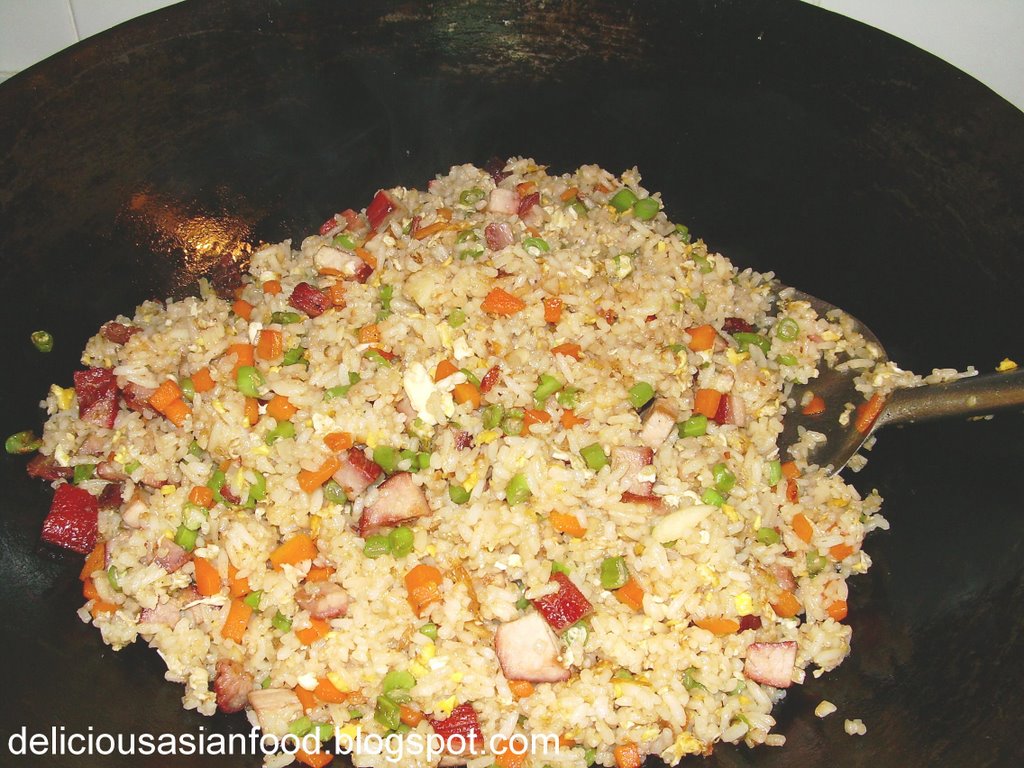
There are many variants of fried rice. In fact, it is only limited by the chef’s imagination. One of the most popular is Egg Fried Rice, a recipe which I previously shared in this site. Another way of frying rice is to add meat to it and this gives the fried rice a good dose of flavour.
Sometimes, I will buy char siew (barbecued pork) from the market and use it as an ingredient in my fried rice. Most of the “tai chaus” (restaurants) also fry their rice this way though I must qualify myself and say that my recipe is more home-style and perhaps, different in some ways. Whilst the list of ingredients may seem long, it is actually not too complicated a recipe if you actually put your hand to it and try it for yourself.
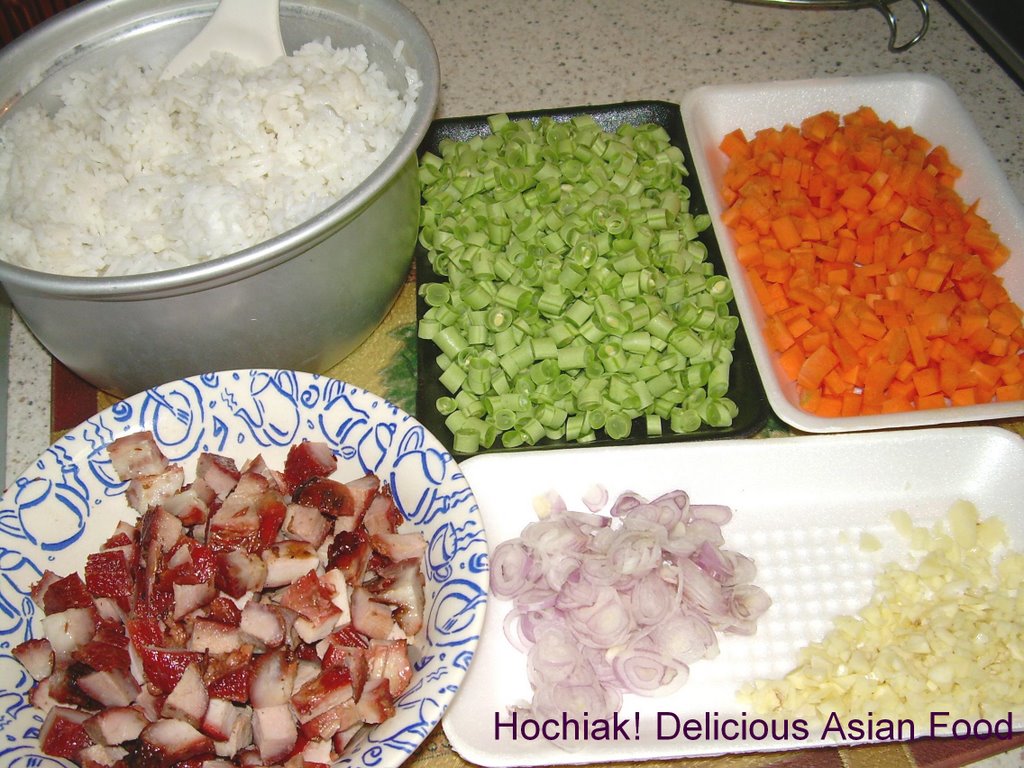
This is my recipe for Char Siew Fried Rice.
Ingredients
- 3 bowls of cooked rice (preferably overnight cooked rice) [bowl denoting rice bowl]
- 1/2 bowl of french beans (cut into tiny cubes)
- 1/2 bowl of carrots (cut into tiny cubes)
- 3/4 bowl of char siew (cut into tiny cubes)
- 5 shallots (sliced thinly)
- 3 bulbs garlic (chopped)
- 3 eggs
- 4 tablespoons cooking oil (preferably palm oil)
Seasoning
- 3 teaspoons of salt
- White pepper powder to taste
- 1 tablespoon oyster sauce
- 2 teaspoon light soya sauce
- 1 pinch of msg (optional)
Method
Heat oil in wok and fry shallots till golden brown. Remove fried shallots and set aside.
With remaining oil in wok and at high heat, add garlic, french beans and carrots and stir fry for 1 minute. Add salt and pepper.
Make a “well” in the wok by pushing the french beans and carrots aside. Break eggs into the “well” and fry it till cooked. Mix with french beans and carrots followed by char siew. Fry and mix well for another 1 minute.
Add rice and stir fry the rice for 2 to 3 minutes whilst adding oyster sauce and light soya sauce. If wish to, add a pinch of msg. (The amount of salt, oyster sauce and light soya sauce can be adjusted to your prefered taste)
Serve hot and sprinkle fried shallots over the fried rice before serving.
source: http://www.deliciousasianfood.com
Label: Char Siew Fried Rice

I was never really a fan of carrot cakes all these while probably because I never had any good experience eating a good carrot cake out there. Maybe the thought of eating a “vegetable” cake deterred me from wanting to try this out compared to chocolate cakes or cheese cakes. Anyway, not any longer ever since we got ourselves a Fagor oven in our new house. Carrot cake rocks! More so when it is topped with lemon cream cheese frosting and eaten slightly chilled.
My wife made this a couple of weeks back and I’m now a fan of carrot cakes. Moist and nutritious, this carrot cake is laden with freshly grated carrots, sweetened pineapples, oven-toasted walnuts and plump raisins. I think the best part that there is no mixer involved (with a little caveat that a mixer would be required to prepare the frosting). Just get yourself a big bowl and spatula and give it a good mix ala manual 
What makes this carrot cake so special that I have decided to call it the Ultimate Carrot Cake Recipe? Well, it’s been handed down from my mother-in-law to my wife, it tastes good as reported by many who have tasted this and most of all, one piece is never enough. Need I say more? 
This is my mother-in-law’s recipe for Carrot Cake with Lemon Cream Cheese Frosting
Ingredients
- 240 grammes carrots (grated)
- 120 grammes pineapples (tinned, drained and chopped)
- 60 grammes raisins (lightly chopped)
- 60 grammes walnuts (toasted, cooled and chopped coarsely)
- 240 grammes self-raising flour
- 1/4 teaspoons cinnamon powder
- 1/4 teaspoons nutmeg powder
- 1/2 teaspoons baking soda
- 1/2 teaspoons baking powder
- 1/2 teaspoons vanilla essence (add to eggs)
- 3 eggs
- 210 grammes castor sugar
- 180 ml cooking oil
Lemon Cream Cheese Frosting
- 60 grammes butter (room temperature)
- 230 grammes cream cheese (room temperature)
- 230 grammes icing sugar (sifted)
- 1 lemon (grate the skin)
Method
Sift the flour with soda and baking powder. Add castor sugar.
Whisk eggs until frothy in a separate bowl. Add in vanilla essence.
Pour egg mixture into the flour and stir well. Then add grated carrots followed by cooking oil. Add in the chopped pineapples and stir well.
Then add in the raisins and walnuts.
Pour mixture into a greased and floured tray and bake in a preheated oven at 170°C for 45 minutes.
Remove from oven and allow to stand to cool before applying frosting.
Frosting
Put cream cheese and butter in the bowl of an electric mixer. Beat on low speed till blended. Gradually add icing sugar (sifted) and continue beating until smooth.
Add vanilla essence and grated lemon and allow to beat till well combined.
 Cabbage Rice with Lap Cheong
This is my 3rd recipe for rice cooked in a rice cooker. Prior to this, I have a recipe for Chicken Rice as well as Long Bean Rice. This is another one of the vegetable rice recipes which can serve as a meal on its own.
Cabbage Rice with Lap Cheong (Chinese Sausages) is quite mild in flavour but sweet in taste. The sweetness comes from the cabbage. The type of cabbage we usually use is the chinese cabbage, which is white in colour and longish in shape rather than round. Try not to leave the rice uneaten overnight as I believe that the cooked cabbage does not withstand being kept overnight that well.
If you don’t have lap cheong, you can even substitute it with ham or even salami! Do experiment. As I have emphasised many times before in my recipes, you can actually experiment with the ingredients once you get the basic idea of how the dishes are cooked. The presentation of the rice in the picture above could be much better but the taste definitely is!
This is my recipe for Cabbage Rice with Lap Cheong (Chinese Sausages)
Ingredients
About 400 grammes of chinese cabbage (shredded roughly)
400 grammes of belly pork (try to get the 3-layered pork. Remove skin)
5 to 8 pieces dried chinese mushrooms (pre-soaked till soft. Remove from water and cut to slivers but retain water for later use)
50 grammes of dried prawns / shrimps (pre-soaked for 5 minutes. Remove from water but retain water for later use)
3 to 5 lap cheong (remove skin and slice thinly diagonally)
5 cloves shallots (sliced thinly)
2 tablespoons of cooking oil (preferably palm oil)
3 bowls of water
Seasoning
1/2 teaspoon white pepper powder
2 teaspoon light soya sauce
2 tablespoon dark soya sauce
A pinch of msg (optional)
Method
Bring water to boil. Add belly pork and let it boil till cooked. Remove pork. Cut into small pieces.
Heat oil in wok and fry shallots till golden brown. Remove fried shallots.
With remaining oil in wok, fry the cooked belly pork till beginning to brown. Remove pork. With remaining oil, fry the dried prawns and chinese mushrooms for 1 minute till fragrant. Add cabbage and put back the pork into the wok and continue to stir fry for 1 more minute. Add seasoning and a little bit of water (used to soak mushrooms / dried prawns) to keep it moist.
Add pre-soaked rice into the ingredients and stir well for 1 minute.
Transfer the ingredients into rice cooker and add water till it covers rice completely just like how you usually cook rice. Turn on the rice cooker. Check occasionally for water to dry out from the upper layer of the rice. Once that happens, place lap cheong on top of the rice, cover lid and wait for rice to cook completely.
Sprinkle fried shallots over rice before serving.
source:http://www.deliciousasianfood.com
Label: Cabbage Rice with Lap Cheong

What a name! Sure, this dish may be common but did you know that simply by putting in a little effort to carve your vegetables, you can create give a new and beautiful breathe of life to an ordinary dish? My little daughters were fascinated with the carrots and broccoli stems which were cut to resemble flowers sitting in the midst of a bed of freshly blanched green broccoli. To give it a more “garden feel”, I used orchid mushrooms as well in this dish. I bought the orchid mushrooms in can and they are quite delicious with a light crunch. You can also use any other suitable mushrooms such as straw mushrooms.
The prawns were cut to resemble like butterflies but being an amateur, I can’t say they look like one. What I did was to remove the heads, middle shell and legs by fingers and leave the tails attached. Next, I use a knife to make a slit down the centre back of each prawn and removed the guts (brownish black thread running down the back of the prawn). When the prawn is cooked, it will give a nice slightly opened shape.
To cut the carrots or broccoli stems into flower-like shapes, you will need to first scrape off the outer layer. Next, cut the carrots into 6 cm lengths. You will need thick broccoli stems for the same purpose. Then, lay the carrot onto a chopping board and make a slanted cut (about 5mm deep or lesser) length-wise along the carrot. Then make another parallel slanted cut just next to it so that both cuts resemble a V shape. You will then be able to remove the whole strip thus leaving you a length-wise groove. Repeat this over the other parts of the carrot until you get at least 5 grooves. Then, slice the carrot sideways and voila! You’ll get the flower-shaped carrots.
Get creative. It makes a whole world of difference to the eating experience!
This is my recipe for Butterflied Prawns in Eden
Ingredients
8 to 10 pieces medium sized prawn (butterflied)150 grammes broccoli (cut into florets. stems cut into flower-shape)
1 medium sized carrot (cut into flower-shape)
1/2 tin of orchid mushrooms
3 cloves garlic (chopped finely)
some cornstarch
300 ml hot water
a pot of water
3 tablespoons cooking oil
Seasoning
1 1/2 tablespoons oyster saucesalt to taste
a couple of dashes of white pepper powder
1 teaspoon of light soya sauce
Method
Bring a pot of water (about 2 litres) to boil. Once boiling, add 2 teaspoons of salt and drizzle some cooking oil. Then blanch broccoli florets till your desired softness. Remove and drain. Place aside to cool. Repeat process with carrots and broccoli stems.
Heat oil in wok. Add half the chopped garlic into the wok together with prawns. Stir fry briskly and add 1 teaspoon of light soya sauce. Remove prawns once it has completely cooked and curled up. Set aside.
Add oil into wok followed by garlic and orchid mushrooms. Stir fry briskly for about 30 seconds before adding 300 ml hot water. Bring to boil and add seasoning to taste. Cover with lid and reduce heat to medium. Allow gravy to reduce to half.
Meanwhile, arrange broccoli florets in a ring on a deep plate. Place carrot and broccoli stem flowers on top of the broccoli florets. Place remaining flowers in the middle.
Check the orchid mushrooms and add some cornstarch to thicken the gravy a little. It should be slightly runny but not watery. Remove from heat.
Scoop some orchid mushrooms and place on centre of the dish. Place prawns on top of orchid mushrooms and flowers before pouring the gravy over the whole dish.
source:http://www.deliciousasianfood.com
Label: Butterflied Prawns in Eden

Yee Mee or Yee Mein (in cantonese) is a type of dried noodles which looks like lengthy rubber-bands. They are brown in colour and usually come shaped like a small cake. It is usually cooked with some sort of rich gravy and in some food courts, you will find it being served on a sizzling hot plate. Though it is quite common, nevertheless, it is still not as popular as the yellow noodles, bee hoon or kuey teow. I think this may have to do with the taste.
In its sold form, the Yee Mee can have a distinctive muski-smell which some might find it a tad artificial. To reduce this “artificial” smell, it is recommended that the Yee Mee be blanched in hot water for a couple of minutes before plunging it into cold water prior to cooking it proper with sauces. You will find that the water used to blanch the Yee Mee will turn brownish and thoroughly unappetising.
In some parts of Malaysia, you can find what is known as Sang Har Meen (fresh prawn noodles) wherein Yee Mee is predominantly used. With that in mind, I decided to cook my very own Braised Seafood Yee Mein using fresh sea prawns and fresh lala clams. I could have boosted the taste further with fresh slices of fish meat and cuttlefish but I couldn’t get my hands on them. Anyway, home cooking is usually not so extravagant. Prawns and lala clams are good enough for this session.
This is my recipe for Braised Seafood Yee Mein
Ingredients
- 4 pieces Yee Mein (1 piece per person)
- 200 grammes lala clams (rinsed thoroughly to remove mud and grime)
- 400 grammes medium prawns (remove shell leaving head and tail intact. Devein. You can also shell it completely. No worries)
- 300 grammes of choy sum (rinse and cut into smaller sizes)
- 3 slices of ginger
- 4 teaspoons chopped garlic
- 500 ml hot water (for cooking)
- 4 tablespoons cooking oil
Seasoning
- 2 tablespoons oyster sauce
- 1 tablespoon light soya sauce
- 1 teaspoon fish sauce
- Salt and pepper to taste
- 1 tablespoon chinese cooking wine
Method
Bring a pot of water to boil and blanch Yee Mee for 2 minutes until semi-soft. Drain and plunge into cold / iced water. Drain.
Heat wok until smoking hot. Add 2 tablespoons oil and 2 teaspoons chopped garlic. As the garlic sizzles, add Yee Mee and stir briskly for 1 minute. Remove and set aside.
In the same wok, add 2 teaspoons chopped garlic and prawns. Stir until prawns have curled up by half. Remove and set aside.
Then add ginger and stir until aromatic. Follow by water and seasoning (except salt, pepper and chinese cooking wine). Bring to boil before adding Yee Mee. Stir well and cover with lid for 1 minute.
Add prawns, choy sum and lala clams. Stir well and cover lid again for an0ther minute. Add salt and pepper to taste followed by chinese cooking wine.
Dish up when prawns have fully curled up and lala clams have opened up. If gravy is too thin for your liking, add a little cornstarch to thicken.
source: http://www.deliciousasianfood.com
Label: Braised Seafood Yee Mein

Ayam Sioh (Chicken in Spicy Tamarind Sauce) is a variant of Duck Sioh (Itik Sioh). This dish is essentially a sour and sweet based stew with a strong hint of tamarind juice (asam jawa) and ketumbar (coriander) spice. I have a feeling that this dish is a Baba-Nyonya Peranakan dish but I stand corrected. Anyway, I was introduced to this dish by my mother-in-law a couple of years back and took a liking to it due to its appetizing taste.
Thankfully, my lovely wife has inherited her mother’s recipe and over the weekend, decided to cook up this dish for Father’s Day lunch. We could not finish the dish as we used 1 whole chicken but we are not complaining because the longer this dish keeps, the tastier it gets. For better results, duck is preferred as the meat is “tougher� to withstand the marinate using tamarind juice. If you can’t find duck, try using “village / kampong� chicken or free-range chicken.
This is my mother-in-law / wife’s recipe for Ayam Sioh (Chicken in Spicy Tamarind Sauce)
Ingredients
1 whole chicken (approximately 1.5 to 2kgs, chopped into large pieces)
Marinade (blend together)
- 200 grammes shallots
- 3 tablespoons ketumbar (coriander) powder
- 225 grammes tamarind (asam jawa) mixed with 350 ml water (squeeze the juice and remove tamarind seeds)
- 10 tablespoons sugar
- 1 tablespoon salt
- 2 tablespoons dark soya sauce
- 1 heaped teaspoon white pepper powder
Method
Wash chicken pieces thoroughly. Marinade chicken overnight or for at least 10 hours.
Transfer chicken and marinate to heavy bottomed aluminium saucepan and boil for 20 minutes over a moderate heat.
Turn the chicken pieces, reduce heat to low and boil for another 20 to 30 minutes or until chicken is very tender.
source:http://www.deliciousasianfood.com